Designing the StarCore Card Layout: Anatomy, Iteration, and What’s Next
Our layout journey has been a process of anatomy, iteration, and refinement—from simple wireframes to faction-specific masterpieces. Here’s a look at how we’ve built the cards of StarCore.

In any trading card game, the layout is the heartbeat of play. It shapes how players read, plan, and react in the heat of battle. For StarCore, we set out to create a design that is not only mechanically clear, but also steeped in the sci-fi atmosphere of our universe.
Our layout journey has been a process of anatomy, iteration, and refinement—from simple wireframes to faction-specific masterpieces. Here’s a look at how we’ve built the cards of StarCore.
📌 Anatomy of a StarCore Card
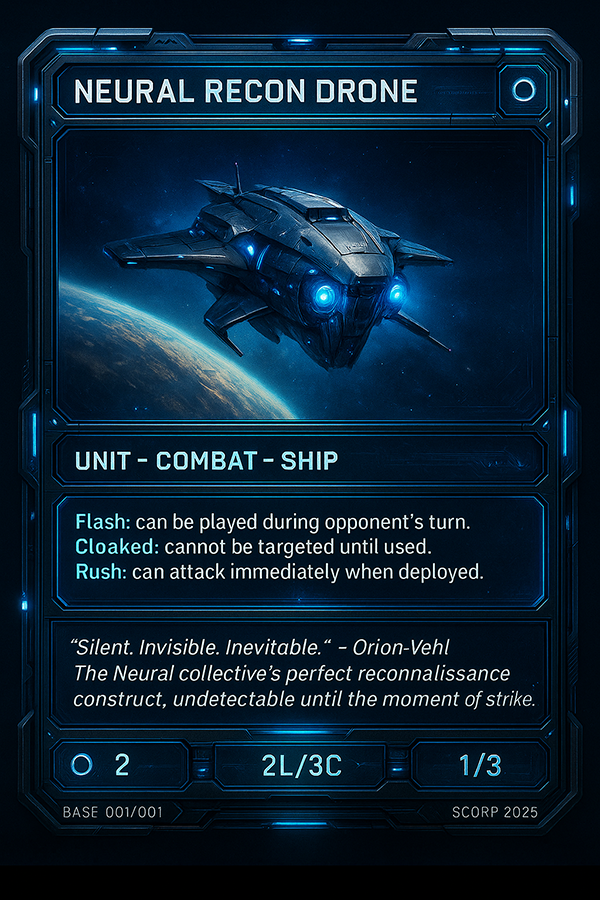
Each StarCore card follows a consistent framework so that no matter which faction you’re commanding, the information is always right where you expect it.
- Name & Rarity – At the very top, the card’s name and rarity badge set its identity. Rarity isn’t just for collecting—it shapes how decks are built.
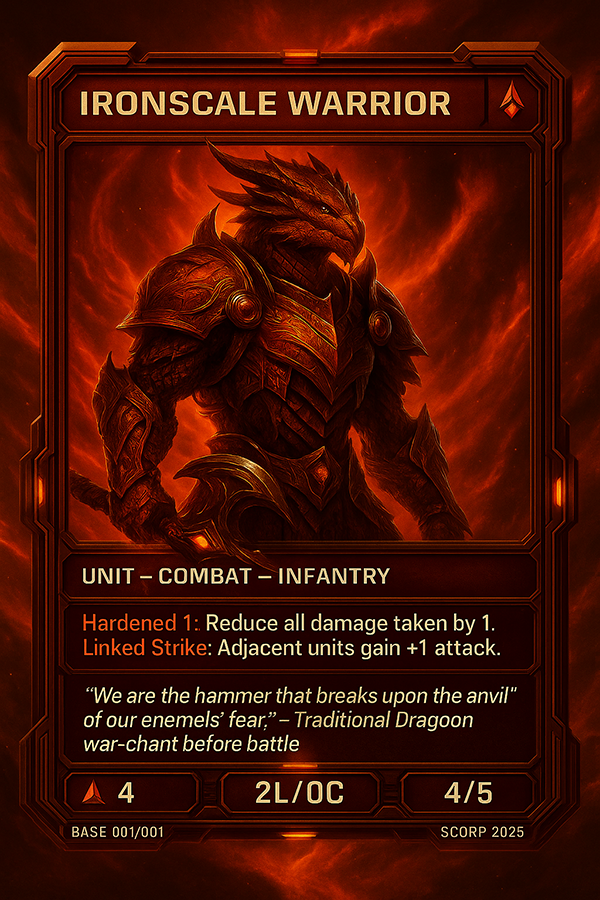
- Faction Frame – Colors and metallic styling communicate the card’s origin instantly: the fiery plating of Dragoons, the sleek digital glow of Neurals, the industrial Sparkforge, or the verdant Stellari.
- Art Box – Striking illustrations bring the galaxy to life, immersing players in faction identity.
- Type Line – Clearly labels whether the card is a Unit, Structure, Module, Utility, Upgrade, Program, Power Core, or Commander.
- Action/Keyword Box – The gameplay engine: concise text, bold keywords, and intuitive formatting for abilities.
- Lore Box – Flavor text ties mechanics back into story, giving every card a narrative weight.
- Cost / Links / Stats – Along the bottom row: resource cost, link/core capacity, and combat stats (attack/defense).
It’s a design built for both clarity in fast-paced gameplay and immersion in StarCore’s world.
⚡ Network-Oriented Design
StarCore’s gameplay revolves around networks, so our cards emphasize connectivity in ways other TCGs don’t:
- Link Ports – Visual cues on card edges reinforce the physical act of connecting cards into a network.
- Capacity & Network Icons – Power Cores and Structures show exactly how many connections they support.
- Scaling Symbols – Adjacent effects and resonant bonuses are called out with easy-to-scan icons.
This turns every card into a tactical node—a piece of a living network that evolves across the battlefield.
🧩 The Iteration Journey
We didn’t land on this design overnight. It’s been a steady evolution, with each step teaching us something new.
1. The Skeleton: Wireframes
We began with rough wireframes, sketching where the name bar, art zone, type line, action text, lore box, and stat row should live. The goal here was functionality—making sure nothing important was hidden or hard to find.
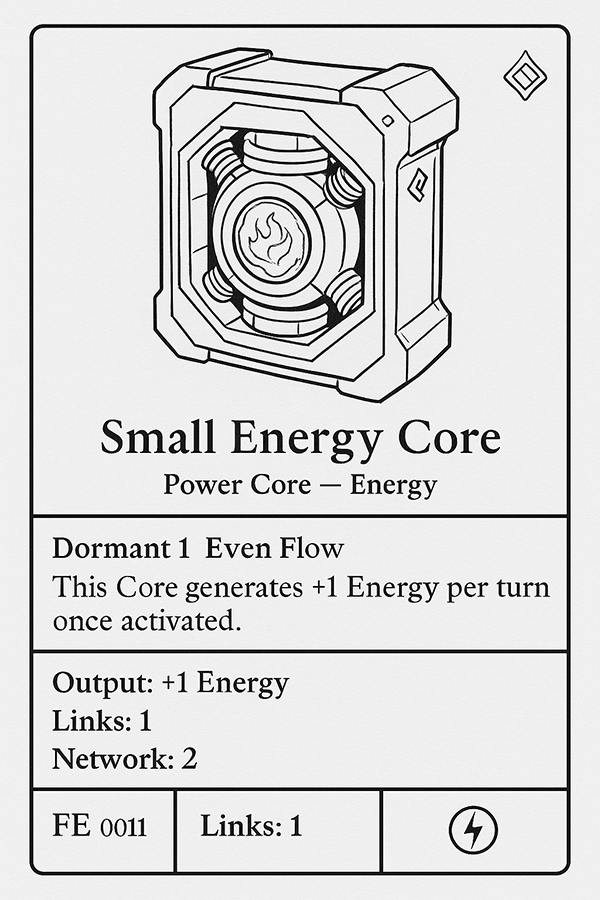
2. The Prototype: Black & White Cards
Next, we tested gameplay with stripped-down, black-and-white prototypes. These included simple line art and placeholder frames.
They weren’t pretty, but they were effective for testing mechanics:
- Was the text readable in live play?
- Did link and network rules translate well to physical play?
- Could players parse costs and stats at a glance?
3. Faction Frames Emerge
With function nailed down, we moved to faction-specific designs:
- Neurals: metallic blues, glowing circuits, cold precision.
- Dragoons: dark reds and plated armor, with a mythic, militant feel.
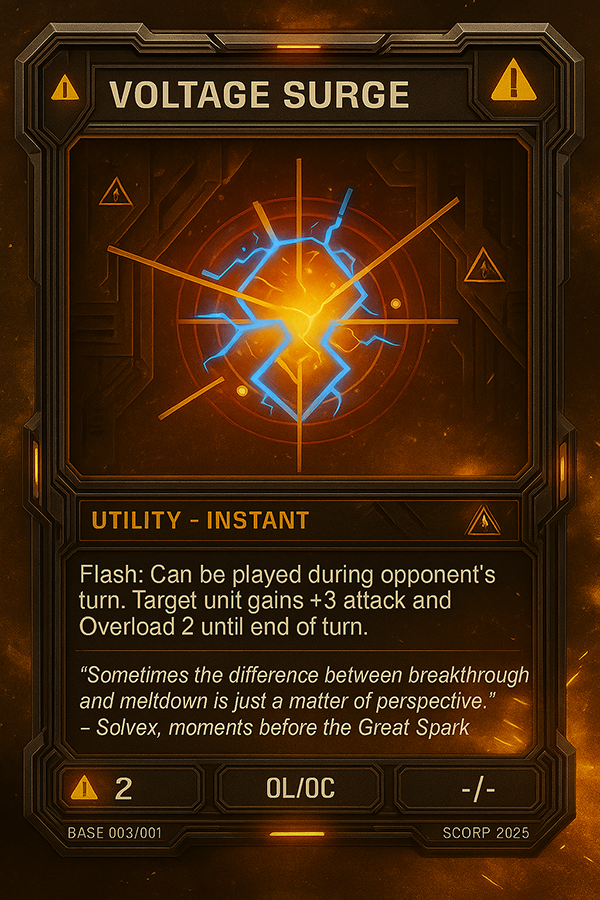
- Sparkforge: industrial oranges and high-energy sparks.
- Stellari: pale greens and organic lines, reflecting growth and balance.
Now, a single glance at the table could tell you who’s fighting who.
4. Polished Showcase Cards
Cards like Ironscale Warrior, Voltage Surge, and the Neural Recon Drone represent our current polished style. These combine faction immersion with clean mechanics, making every card both beautiful and practical in live play.
🎯 Why This Layout Matters
Card games succeed or fail on readability and flow. The StarCore layout is designed to:
- Keep stats and actions front-loaded for quick scanning.
- Emphasize links and networks, reinforcing what makes StarCore unique.
- Balance immersive art and flavor with mechanical clarity.
When you play a StarCore card, you’re not just dropping a piece of cardboard—you’re deploying a strategic node, a story fragment, and a faction identity that could shift the tide of war.
🚀 What’s Next
We’re proud of how far the card layout has come, but we’re still iterating. Our next steps include:
- Iconography pass – refining symbols for universal clarity.
- Accessibility checks – ensuring color choices are legible for all players.
- Printing tests – adjusting contrast and spacing for durability and table play.
The StarCore card layout is a language we’re still refining. Each iteration brings us closer to a system that is not only strategically functional, but also artistically unforgettable.
✨ From wireframe to polished prototype, from mechanics to story, the StarCore card layout represents the fusion of design, gameplay, and worldbuilding. And the best part? We’re just getting started.